For months, I set up the AI wrong without knowing it. Every task, I typed the same paragraph first. "My readers are mid-career designers. Don't use these words. Keep it short. Sound like me, not a brochure". Every single time — like onboarding an assistant with overnight amnesia.
The fix was learning to set up an AI skill properly. One feature, written once, that the AI reads before every task. It changed how my whole day runs.
But it ends with a small, stupid detail that quietly cost me an afternoon — and that's the part nobody mentions. It's at the bottom. Stay with me.
The fix was learning to set up an AI skill properly. One feature, written once, that the AI reads before every task. It changed how my whole day runs.
But it ends with a small, stupid detail that quietly cost me an afternoon — and that's the part nobody mentions. It's at the bottom. Stay with me.
How to set up an AI skill (the thing I should have done on day one)
Quick Context: I’m using Claude for this specific post because its "Projects" and custom instruction features handle design assets beautifully. However, the logic is universal—if you use ChatGPT, Gemini, or other major tools, you can apply these same principles using their customization features. The platforms might use different terminology, but they share the same underlying logic. Just keep in mind that these advanced configuration tools are generally locked behind the paid pro subscriptions of each platform.
A skill is a set of instructions the AI reads every time, before it touches the work. You write it once. It applies itself when the task fits. Stop prompting, start configuring. This is not a Claude-only thing — most serious AI tools have a version of it now.
Quick Context: I’m using Claude for this specific post because its "Projects" and custom instruction features handle design assets beautifully. However, the logic is universal—if you use ChatGPT, Gemini, or other major tools, you can apply these same principles using their customization features. The platforms might use different terminology, but they share the same underlying logic. Just keep in mind that these advanced configuration tools are generally locked behind the paid pro subscriptions of each platform.
A skill is a set of instructions the AI reads every time, before it touches the work. You write it once. It applies itself when the task fits. Stop prompting, start configuring. This is not a Claude-only thing — most serious AI tools have a version of it now.
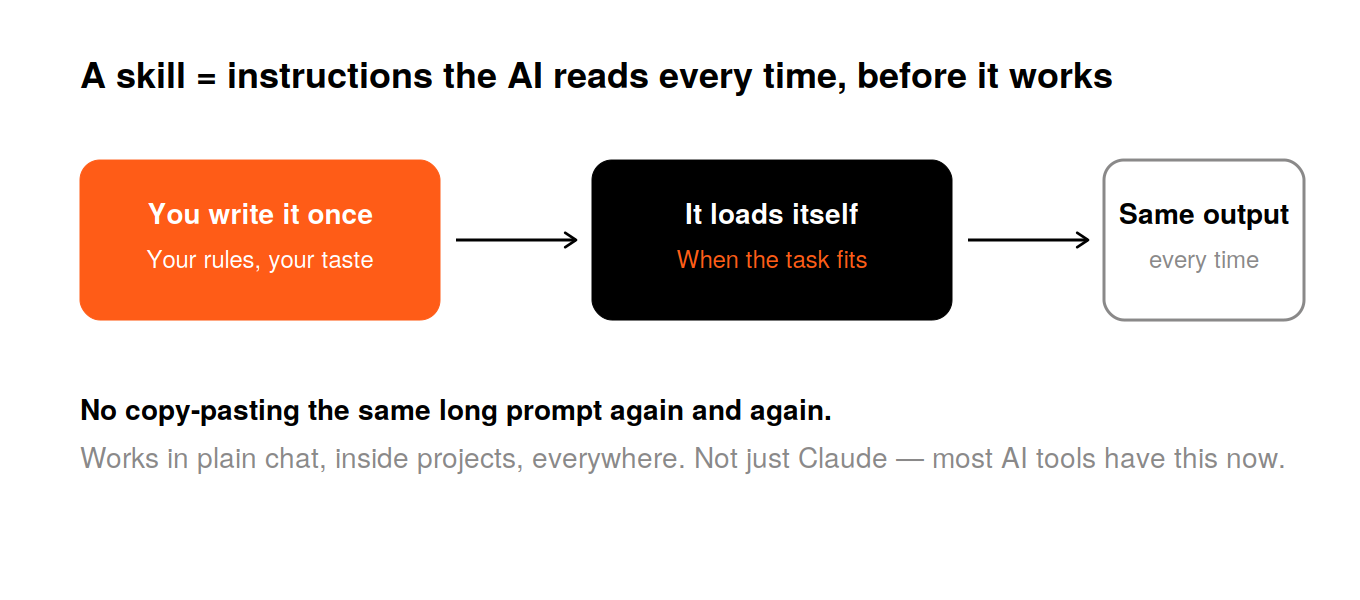
The shift is small but it changes everything downstream: your taste stops living in your head and starts living in a file the machine reads back to you, perfectly, on every task.
Don't write the skill yourself. Make the AI interview you.
This is the move I wish someone had handed me. If you try to write the skill alone, in one clean pass, you'll forget half of what makes your work yours. You're too close to it.
So flip it. Describe what you want, then tell the AI to ask:
"I want a skill that writes my posts in my voice. Before you write anything, ask me every question you need."
Don't write the skill yourself. Make the AI interview you.
This is the move I wish someone had handed me. If you try to write the skill alone, in one clean pass, you'll forget half of what makes your work yours. You're too close to it.
So flip it. Describe what you want, then tell the AI to ask:
"I want a skill that writes my posts in my voice. Before you write anything, ask me every question you need."
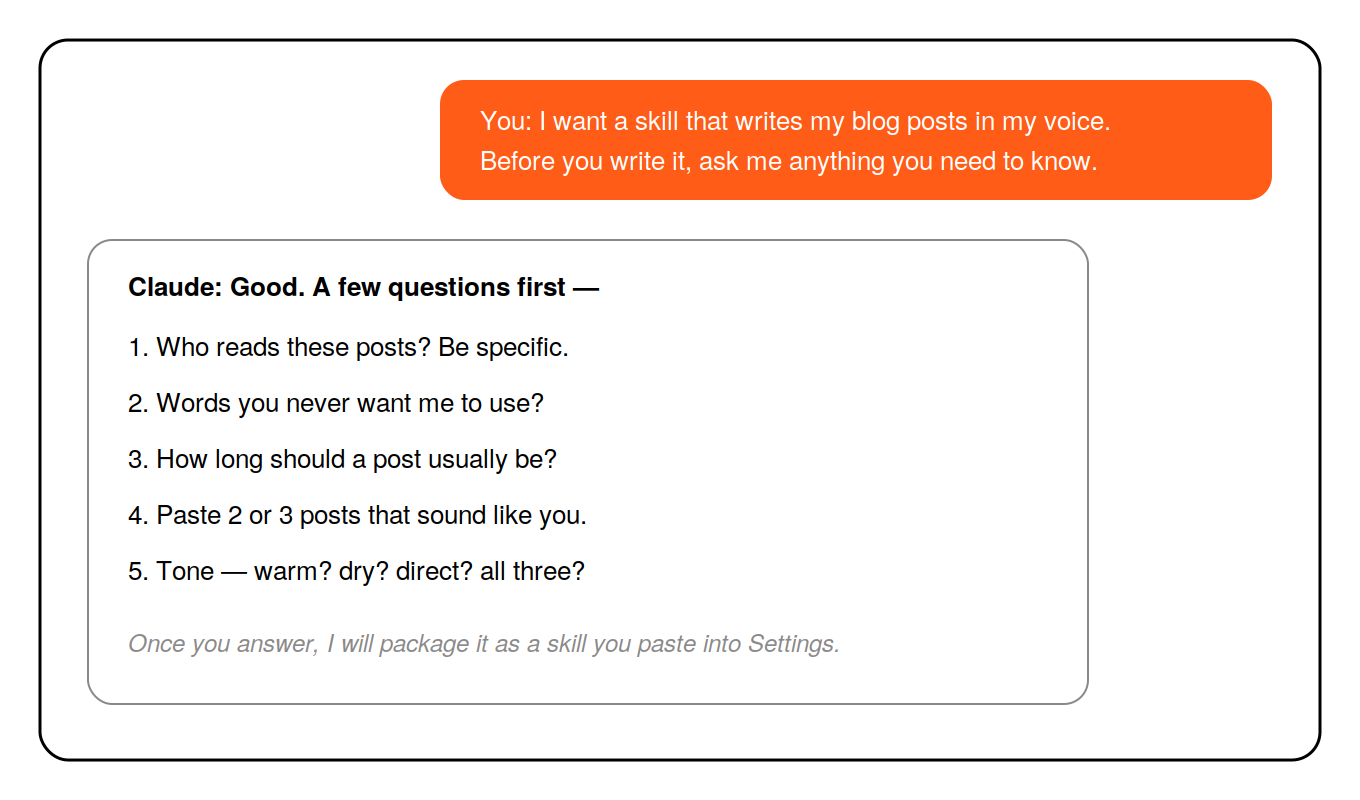
It asks about your audience, your banned words, the length, your tone, etc. You answer in your own messy way — typos and all. Then it packages the whole thing into a skill. You copy it and paste it into settings. done!
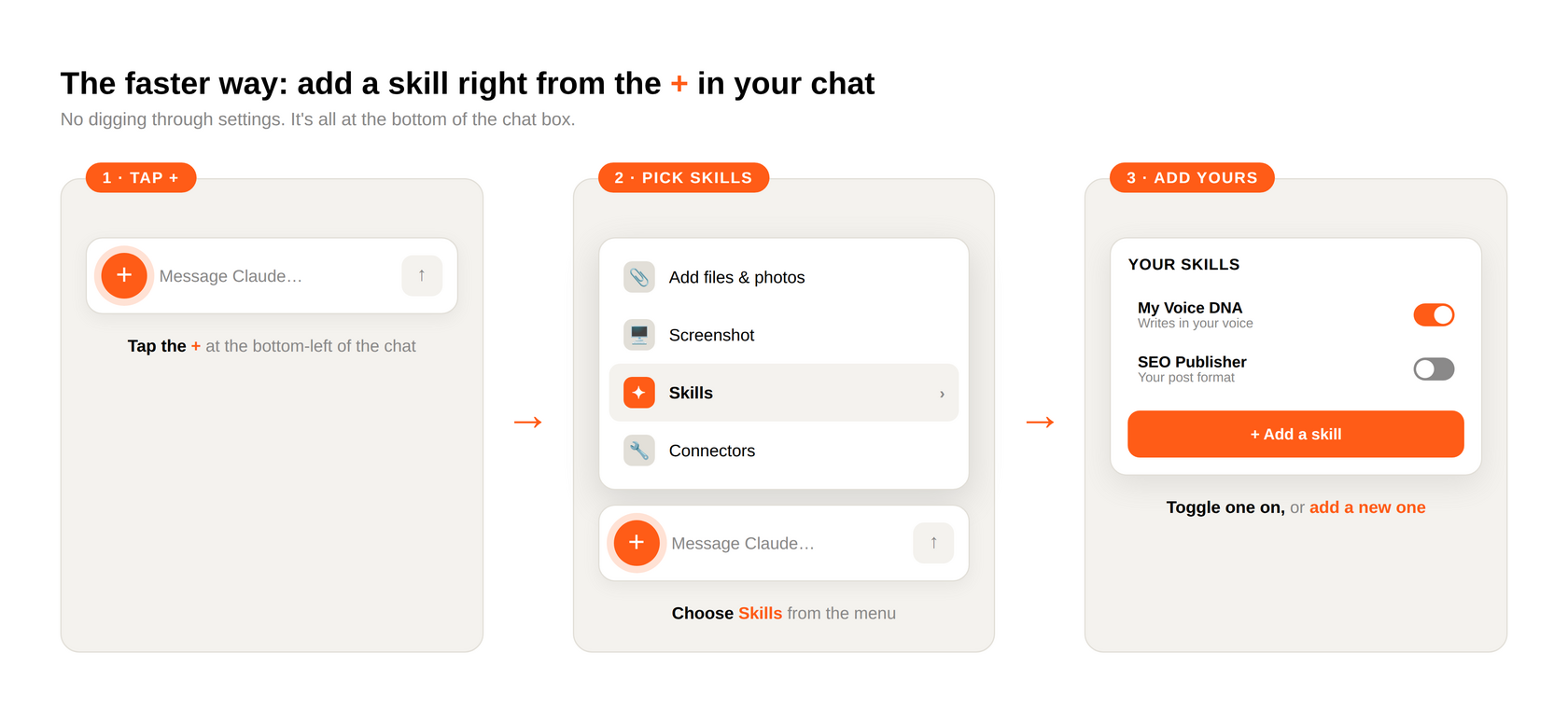
or
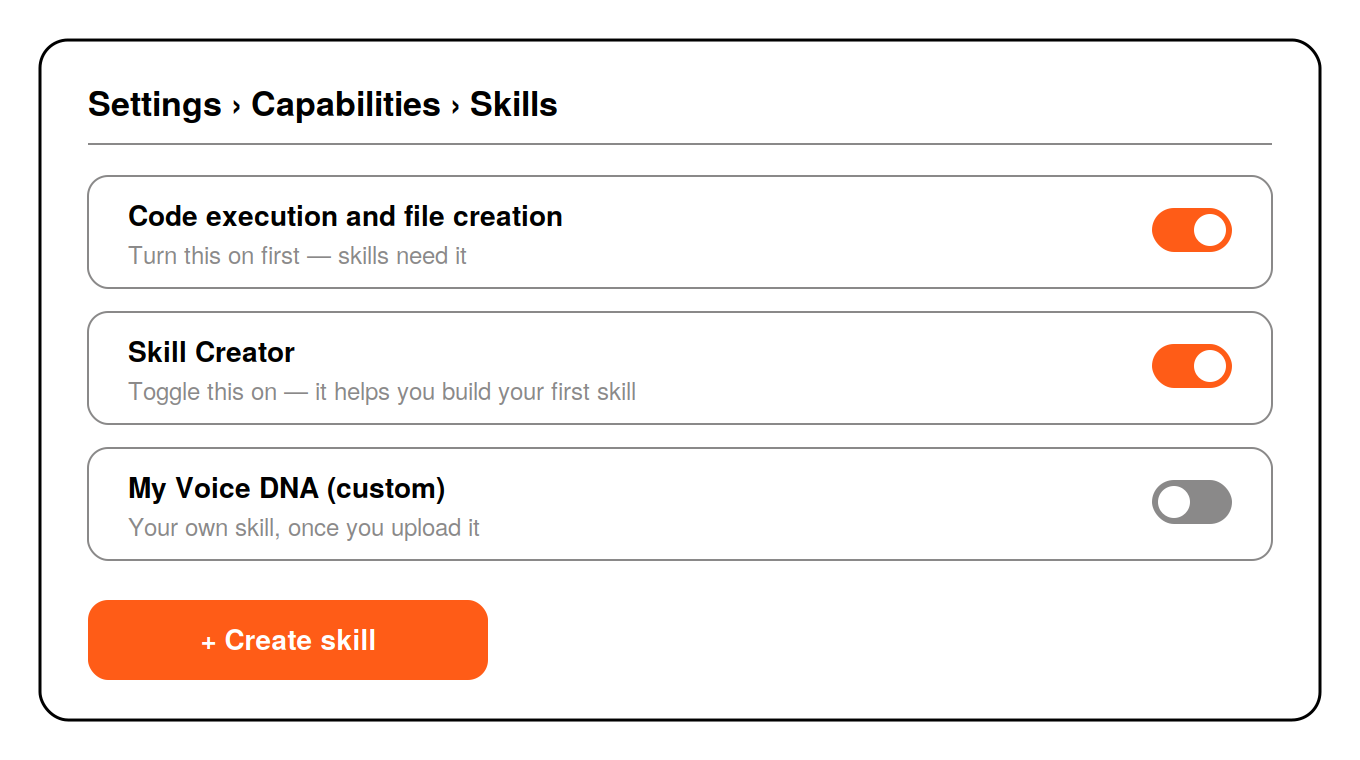
If you want the groundwork first — the things worth understanding about AI before you design anything with it — I wrote a set of notes on the fundamentals. That's the post I wish I'd read before I started.
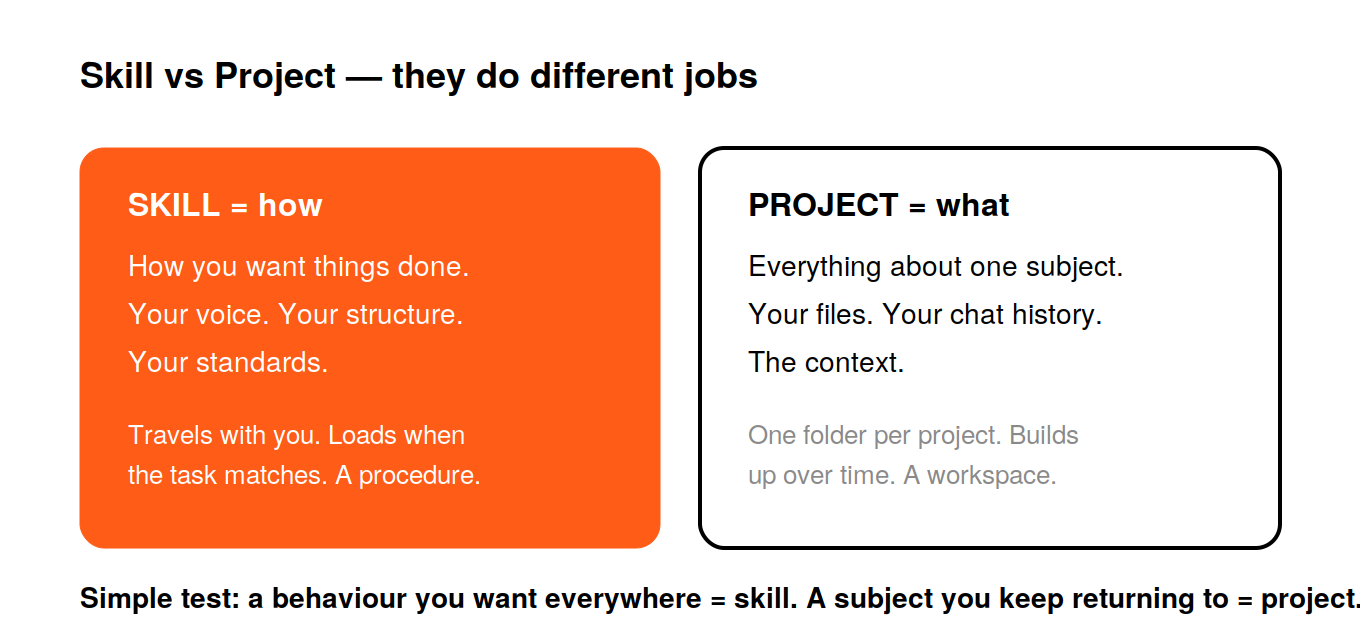
Skills and projects are not the same thing. Most people blur them.
A skill is how you want things done. A project is what you're working on — one subject, with its own files and its own history living in one place.
Skills and projects are not the same thing. Most people blur them.
A skill is how you want things done. A project is what you're working on — one subject, with its own files and its own history living in one place.
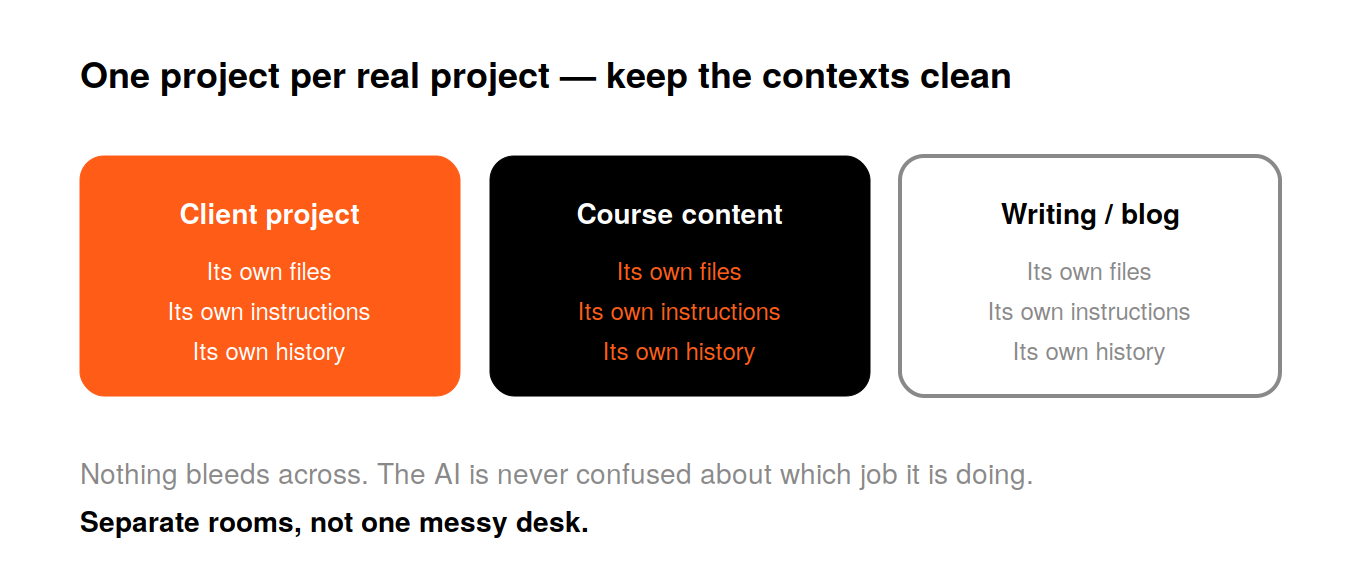
I keep a separate project for each real thing I'm working on. A client job in one. Course material in another. My trip ideas somewhere else again. Nothing bleeds across. The AI is never sitting there quietly confused about which job it's in — which, it turns out, is most of why AI output feels generic. It's holding too many unrelated things at once.
Each project gets its own instructions, and those keep growing. When a correction comes up again and again — a format I always want, a mistake I keep fixing by hand — I stop fixing it manually and write it into the project instructions. Over time the instructions become a quiet record of everything I learned the hard way. The AI gets sharper while I do less.
The one-line detail that actually changed how I work
Here it is. The thing I promised.
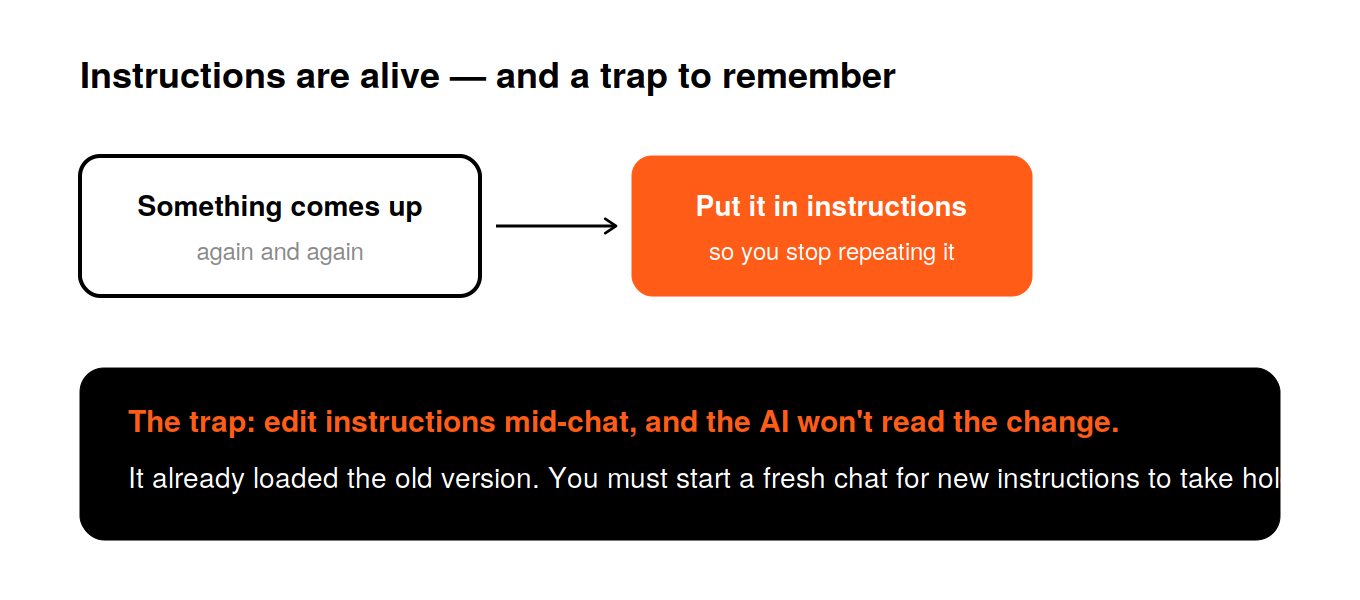
Update the instructions in the middle of a chat, and the AI won't read your change. It already loaded the old version the moment the chat opened. Nothing you edit mid-conversation lands. You have to open a fresh chat for new instructions to take hold.
The one-line detail that actually changed how I work
Here it is. The thing I promised.
Update the instructions in the middle of a chat, and the AI won't read your change. It already loaded the old version the moment the chat opened. Nothing you edit mid-conversation lands. You have to open a fresh chat for new instructions to take hold.
I lost an afternoon to exactly this. Kept editing the instructions, kept getting the old behaviour, kept deciding the tool was broken and I was stupid. The tool was fine. I was editing a page it had already finished reading.
What it changed in my head: I stopped treating a chat as an open conversation that absorbs everything as I go, and started treating it as a session with a fixed brief. Set the rules. Open a clean chat. Keep it short and sharp. Close it before it gets bloated and tired. A short focused chat beats a long exhausted one — for the AI, and, I've noticed, for me too.
That's the whole thing. Not a hack. Just the small mechanical truth that stops you fighting the tool and lets you start directing it. Most "AI doesn't get me" frustration is really this — instructions in the wrong place, or read at the wrong moment.
What it changed in my head: I stopped treating a chat as an open conversation that absorbs everything as I go, and started treating it as a session with a fixed brief. Set the rules. Open a clean chat. Keep it short and sharp. Close it before it gets bloated and tired. A short focused chat beats a long exhausted one — for the AI, and, I've noticed, for me too.
That's the whole thing. Not a hack. Just the small mechanical truth that stops you fighting the tool and lets you start directing it. Most "AI doesn't get me" frustration is really this — instructions in the wrong place, or read at the wrong moment.
I'm figuring out what's worth teaching by testing it in public — the wins and the wasted afternoons. Get the next one as I write it →
See you next time,
p.s. Working with AI Is Exhausting. Nobody Is Saying That.
Testing in public so the good stuff makes it into how I teach how I teach
p.s. Working with AI Is Exhausting. Nobody Is Saying That.
Testing in public so the good stuff makes it into how I teach how I teach